



There is a saying that gets repeated often enough to have worn smooth: comfort is the enemy of growth. Like most sayings worn smooth, it is both true and dangerously incomplete.
Some discomfort has no lesson in it. A broken leg is not trying to teach you anything. A torn ligament is not a growth opportunity in disguise. That kind of pain is simply damage, and the correct response to it is to treat it, not to sit with it and wait for wisdom to arrive. Anyone who has done physical work for a living knows this instinctively. You do not build character by ignoring a torn rotator cuff. You build a permanent injury.
But there is a second kind of discomfort, and it behaves nothing like the first. It is the tightness in the chest before you say the thing that needs saying to a coworker, a spouse, a fellow parishioner, a fellow citizen. It is the hesitation before raising a grievance you know will not be welcomed. This discomfort is not damage. It is a signal, in the way a warning light on a dashboard is a signal. It is telling you that something is misaligned and wants attention. Treating it the way you would treat a torn ligament, as something to avoid, protect, and wait out, does not lead to healing. It leads to the thing underneath it getting worse in the dark.
Most people can tell these two kinds of pain apart when the stakes are personal. Almost no one is taught to tell them apart when the stakes are social. So the discomfort of an honest conversation about race, wages or who a political movement is actually asking you to become gets treated like a broken leg. It becomes something to avoid, something to protect against, something to let heal on its own by simply not touching it. The conversation does not happen. What needed saying does not get said. Everyone involved calls the resulting silence peace.
It is not peace. It is the absence of the argument that peace would have required.
There is a third kind of discomfort worth naming because it hides inside the other two and makes both harder to see clearly. This is the discomfort of having your own status questioned, the unease that shows up not because a conversation threatens your safety or your relationships, but because it threatens your sense of where you stand relative to other people. This discomfort dresses itself up as prudence. It says things like, “We shouldn’t divide people,” “Now isn’t the time,” or “That’s not really about race; it’s about something else.” It sounds like peacekeeping. It functions as ego protection. And it is, by a wide margin, the discomfort most responsible for the conversations that never happen because it is the hardest one to admit to feeling.
This is the discomfort this essay is actually interested in. Not the broken leg, which needs treatment, not silence. Not the honest, hard conversation, which needs to be had, not avoided. But the third kind: the flinch that happens when a person is asked, even gently, to consider what they have been getting out of an arrangement they have never had to examine and whether they would be willing to give some of it up.
Chesterton, writing decades before any of this, drew a related distinction. “There is a case for telling the truth; there is a case for avoiding the scandal; but there is no possible defense for the man who tells the scandal, but does not tell the truth.” A scandal and a truth are not the same disclosure. A scandal exposes a person. A truth exposes a condition.
Following that same train of thought, a further distinction is worth drawing: Peace bought by silence is not peace at all, but a postponement. It has the shape of peace, the quiet of peace, even the relief of peace. What it does not have is the settlement peace requires. A debt that is not called due has not been forgiven. It has only not yet been collected.
This is the same counterfeit that shows up when freedom curdles into license. License wears freedom’s clothes convincingly enough that it takes a moment to notice what is missing: the responsibility that made the freedom real in the first place. Postponement works the same trick on peace. It borrows peace’s calm, its lack of visible conflict, everything peace looks like from the outside, while quietly discarding the one thing that made the calm trustworthy, namely, that something true had actually been settled. License is freedom that has stopped paying for itself. Postponement is peace that has stopped paying for itself. Both hold together only as long as nobody asks what happened to the bill.
Indiana would get its scandal in 1925, in vivid and humiliating detail. It would not get the truth for a long time after, if it has gotten it yet.
The wage itself
W.E.B. Du Bois gave this debt a name. Writing in “Black Reconstruction in America,” he described what white workers in the post-Reconstruction South were actually paid in place of the material solidarity that shared class interest should have produced. He called it the psychological wage: public deference, unrestricted use of public spaces, favorable treatment in the courts, a policing system that worked for them rather than against them and, above all, standing. Not wealth. Standing. The felt certainty of not being at the bottom, regardless of how close to it one actually stood economically.
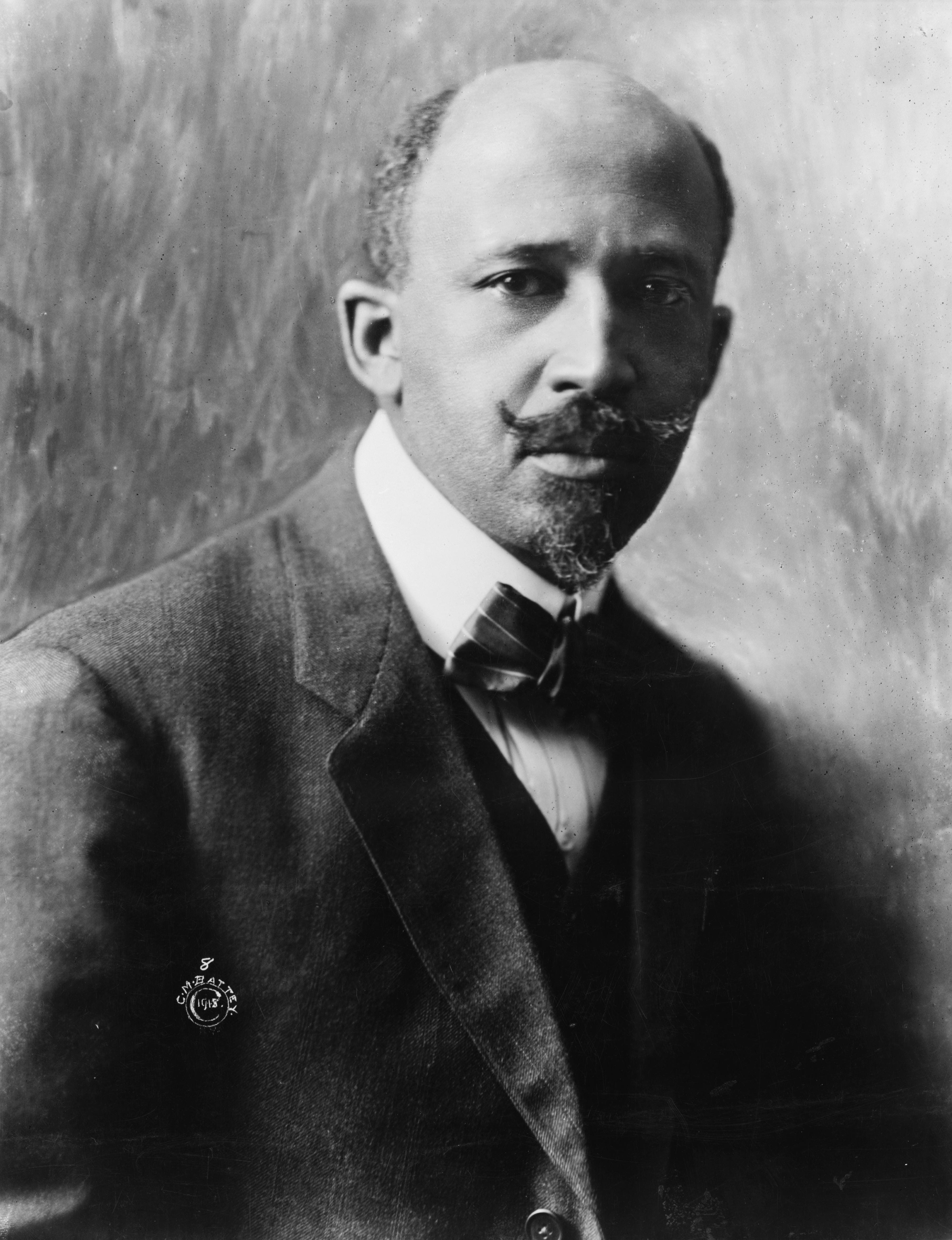
W.E.B. Du Bois in 1918
This wage cost employers almost nothing to grant. It did not require raising anyone’s pay. It did not require improving anyone’s working conditions. It required only that the existing hierarchy be left in place and periodically reaffirmed, so that a mill worker earning near nothing could still walk away from his shift with something a Black worker doing the same job could not have: the assurance that there was a floor beneath him that could not move, no matter how far his wages fell.
Du Bois’s insight was not that white workers were simply deceived. It was that the wage was real. It bought something. That is what made it effective, and it is also what made it a trap. A worker who has been sold a fiction can be argued out of it. A worker who has been paid an actual, if narrow, dividend has to be asked to give something up, and asking a person to give up something real is a harder conversation than correcting a misunderstanding. This is the conversation Du Bois identified as the one that kept not happening. It would have required white and Black workers to recognize a shared material interest large enough to be worth more than the psychological wage each side had been offered to keep them apart.
It is worth being exact about what kind of discomfort this created, using the distinction from the previous section. The conversation Du Bois was calling for was not a broken leg. It was not damage to be avoided. It was diagnostic, a signal that something in the arrangement of labor and race in America was misaligned and needed correcting. But the people who stood to lose the wage received it as though it were a broken leg, as though naming the arrangement were itself the injury rather than the arrangement being the injury and the naming being the treatment.
That confusion is the third kind of discomfort at work, the one dressed as peacekeeping while actually functioning as status protection. Nobody organizing against cross-racial labor solidarity in the 1870s and 1880s framed that resistance as a defense of status. They framed it as a defense of decency, order or the way things had always been done. Status protection rarely announces itself honestly. It borrows the language of whatever virtue is most available at the time: peace, tradition or unity. It wears that language until the wearing becomes indistinguishable from belief.
The psychological wage did not stay in the 19th century, and it did not stay confined to labor economics. It is portable. It attaches itself to whatever institution is willing to keep paying it out, and in the 1920s, in a state that had elected a governor with Klan backing and seated a legislature the Klan effectively controlled, one of those institutions had a name, an address, and a robe.

The cost of having said it
It would be dishonest to write about avoided conversations without acknowledging why avoidance has always seemed like the wiser bet. Fear of this particular discomfort is not simply cowardice or comfort-seeking. It has evidence behind it, and the evidence is a body count.
Malcolm X was building toward exactly this kind of conversation, one that connected race to economics and refused to let either be discussed in isolation, when he was assassinated in 1965. Martin Luther King Jr. was murdered in 1968 while organizing the Poor People’s Campaign, a coalition explicitly built across racial lines around the shared fact of poverty, not the more comfortable and more segregated fact of civil rights alone.
Fred Hampton, still in his 20s, was building the Rainbow Coalition in Chicago, a genuine alliance of the Black Panthers; the Young Patriots, a group of poor white Appalachian migrants; and the Young Lords, a Puerto Rican organization. The coalition was built around the recognition that poor people across racial lines shared a landlord, a lender and a set of interests worth organizing together. Hampton was killed by police in his bed in 1969, in a raid coordinated with the FBI’s COINTELPRO program, specifically because that coalition was working.
This is worth sitting with rather than rushing past. The people who came closest to having the actual conversation, the one that named the psychological wage and asked people to trade status for solidarity across racial lines, did not face social awkwardness for it. They faced the full weight of the state. That history does not excuse the silence that followed it. But it explains it. A society watches what happens to the people who try and draws conclusions. Given what they had seen, the conclusion most people drew was not wrong. It was simply the wrong conclusion to keep drawing forever.
The question this essay is asking is not why people have been afraid to have this conversation. The fear is reasonable. The question is what it costs, generation after generation, to keep deciding that the fear should win.
Defining terms honestly
Before returning to Indiana in the present tense, two terms this essay has been circling need to be defined rather than merely deployed because both are used loosely enough in current debate to generate more heat than light.
“Christian nationalism” is used in two different ways. Used narrowly, it names a specific claim: that America is, or should be, formally and legally a Christian nation, with public life, law and often citizenship itself ordered around a particular Christian identity, typically white and Protestant, to the exclusion of other faiths and other Americans. This is the sense in which the term describes an actual movement with actual figures, publications and policy goals, not a mood or a vibe.
Used broadly, the term gets applied to any fusion of Christian conviction and political engagement, including ordinary religious conservatism that most Christians across most of American history would recognize as unremarkable. Critics on the right have a legitimate complaint when the broad usage gets deployed this loosely because it treats devout political engagement itself as suspect. This essay uses the term narrowly: not people who bring their faith into public life, which the church has always asked of its members, but a specific claim of ethnic and religious entitlement to the nation itself, dressed in Christian language and, in its worst versions, willing to use the same tools the Klan used a century ago: intimidation, exclusion and the promise of restored status to anyone willing to accept the hierarchy on offer.
“White privilege” suffers from a similar problem: It is often heard as an accusation even though it was built as a description. The claim is not that individual white people did not work hard or did not earn what they have. Most did. The claim is structural: The systems surrounding that hard work, including courts, lending, policing, hiring and housing, were built in ways that granted white citizens a floor other citizens were denied by law and custom, often within living memory. That floor is not a personal moral failing. It is an inherited advantage, no more chosen by any individual than the color of their eyes.
Both terms point at the same thing from two directions. White privilege names the structural residue of the psychological wage, the parts that outlasted the explicit hierarchy that paid it out and were quietly built into the systems themselves. Christian nationalism, narrowly defined, names a live movement trying to reissue that wage in religious language, openly and on purpose. Naming the structure is not an attack on the people standing inside it. It is an invitation to see the floor for what it is so that the choice to keep it, share it or dismantle it can actually be made, rather than defaulting to whatever the system already decided a century ago. The movement depends on that invitation never being accepted. It needs the floor to feel earned rather than granted because a floor recognized as an inherited advantage can be questioned, while a floor felt as simple superiority cannot.
The anthropology problem
Here the critique has to be made from inside the tradition it is aimed at, because that is where it actually lands with force. This is not a case of Catholic social teaching being invoked against an external enemy. It is Catholic social teaching recognizing a counterfeit of itself.

The entire architecture of Catholic anthropology rests on one claim, stated plainly in Genesis and never revoked: Every human being is made in the image of God. Not every white human being. Not every native-born human being. Not every human being of the correct confession. Every human being, full stop, prior to and independent of any status a society is willing to grant them. “Rerum Novarum” grounds the dignity of the worker in this, not in the worker’s productivity, citizenship or race. “Laborem Exercens” does the same. The entire distributist tradition, Chesterton and Belloc included, treats the human person as bearing a dignity too fundamental to be parceled out unevenly by rank or birth.
A movement that offers status in exchange for racial or religious identity is not applying this anthropology. It is inverting it. It is taking the language of a faith whose founding anthropological claim is universal human dignity and using that language to sell a good that only works if dignity is scarce and unevenly distributed, because a status wage has no value unless someone else is excluded from it. You cannot be paid in standing if everyone stands at the same height. The wage requires a hierarchy to exist at all, and Christian nationalism, in the narrow sense defined above, is in the business of manufacturing that hierarchy and calling it Christian.
This is not a both-sides argument, and it should not be softened into one. It is a claim that a specific movement, if it is doing what it appears to be doing, has an anthropology in direct conflict with the theological tradition it claims to represent. Naming that conflict is not an attack from outside. It is a family argument, the kind the Church has always been willing to have with itself, and the kind this movement has been mostly spared, because too many people found the conversation more uncomfortable than the alternative.
The tradition being invoked against itself here also supplies its own corrective, which is worth naming rather than leaving implicit. Subsidiarity holds that dignity and decision-making belong first at the smallest workable scale: the person, the family, the parish, the union hall. Those are precisely the scales at which a person can be known rather than sorted. A hierarchy of racial or religious standing does the opposite. It decides a person’s worth at the largest possible scale, by category, before anyone has met them. A church faithful to its own anthropology does not need to import a theory of human dignity from outside. It already has one, and the work in front of it is simply refusing to let that theory be quietly swapped out for a cheaper one wearing its vestments.
When power feels the threat
There is a reliable pattern worth naming plainly. When a movement threatens to organize people across the lines that a psychological wage depends on, the response from entrenched power rarely stays in the realm of argument for long.
The internalization happens first, and it happens on the receiving end of the conversation, not the giving end. Tell a person their wage was granted rather than earned, and the instinct is not to examine the claim. It is to defend the self because the claim is heard as an attack on effort and character rather than a description of structure. This is the same third discomfort named earlier, dressed now in the language of fairness: “I worked for what I have, so how dare you say I did not earn it?” Nobody is saying that. The claim was never about effort. It was about the floor beneath the effort, the one that was not equally available to everyone doing the same work. But defensiveness does not wait to hear the distinction. It reacts to the sentence before the sentence finishes.
The second pattern shows up when a movement gets past that defensiveness and starts building the coalition the wage was designed to prevent. The recent history of the Democratic Socialists of America is instructive here, not because the organization is beyond critique. It is not. Rather, the response it has drawn from entrenched interests illustrates the point cleanly. When a movement starts connecting economic precarity across racial and ethnic lines, the pushback rarely stays confined to policy disagreement. It escalates toward delegitimization, toward painting the coalition itself as dangerous or un-American, toward the kind of organized resistance that treats the coalition as the threat rather than the conditions the coalition is responding to.
This pattern is not confined to the last century. In January 2026, Renée Good and Alex Pretti were killed within 18 days of each other and less than 2 miles apart in Minneapolis, both while bearing witness to the same aggressive federal immigration operation.
Pretti was filming agents in the street and had stepped between an officer and a woman who had just been thrown to the ground, putting himself bodily between enforcement and the person it was targeting, when he was pepper-sprayed, tackled and shot by U.S. Customs and Border Protection officers. Good was stopped in her car near the same operation when agents surrounded her; she was shot as she pulled away. Neither had set out to build a movement the way Malcolm X, King or Hampton did. But both died standing, in different ways, against a style of enforcement that the state has learned to justify in the same terms Christian nationalism uses to justify hierarchy elsewhere: a rhetoric of restored order, lawful belonging and who does and does not have a right to stand on American ground.
Federal officials characterized Good’s death as justified self-defense against a “weaponized” vehicle, while the communities responding to both killings organized across racial and immigration-status lines in vigils, strikes and marches that spread from Minneapolis outward. Power’s instinct, confronted with people organizing across those lines in real time, was not to answer the organizing. It was to reframe the people killed as the threat.
There is a harder truth sitting underneath these two deaths, one this essay should not smooth over. Malcolm X, King, and Hampton chose the conversation, knowing roughly what it might cost them. Good and Pretti did not choose a confrontation with the state so much as happen to be standing in a place where one was already underway, and it found them anyway. That is its own kind of evidence, and it cuts against the comfort of thinking caution can reliably purchase safety. Sometimes it does. Sometimes the danger was never conditional on what you were brave enough to say.
This is Fred Hampton’s Rainbow Coalition again, in a different decade, facing a version of the same instinct, updated in method but not in motive. Power does not fear people being poor, or afraid, or grieving. Power fears people being poor, afraid, or grieving together, across the lines it has spent generations maintaining.
Given that history, it would be dishonest to close this essay by asking people simply to be braver, as though courage were the only ingredient missing. What is being asked for is not recklessness. It is the willingness to have the conversation anyway, publicly, honestly and without flinching from the discomfort that conversation produces, understanding fully what the discomfort has cost people who went before. In hockey terms, dropping the gloves does not mean starting a fight nobody can survive. It means being willing to stand in the moment when backing down would be easier and staying standing. That is a different thing than martyrdom, and this essay owes its reader that distinction plainly: This is a call to public honesty and organized solidarity, not to anything that invites the fate of the people just named.
Indiana, Never Left
A debt not called due has not been forgiven, this essay argued early on. It has only not yet been collected. Indiana is where that claim stops being an abstraction and becomes a matter of public record.
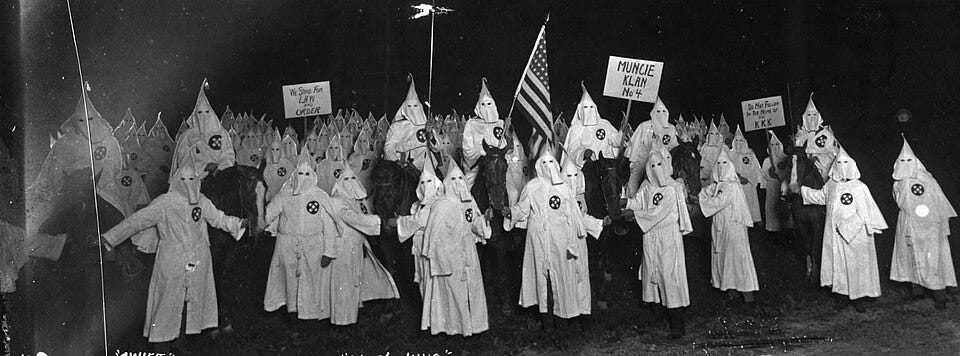
Members of the Ku Klux Klan in Muncie, Indiana, in 1922
In 1925, Indiana had a chance to have an honest conversation about itself, and a courtroom in Noblesville had it instead.
D.C. Stephenson, grand dragon of the Indiana Klan and, in his own estimation, “the law in Indiana,” was convicted of the kidnapping, rape and murder of Madge Oberholtzer. Within a year, the organization that had elected a governor, seated a majority of the state legislature and enrolled something close to a third of the state’s native-born white men was crippled and discredited. Historians mark this as the end of Klan power in Indiana. It is usually told as a story with a moral: The truth came out, the villain was punished, decency reasserted itself.
It is worth being precise about what actually happened because the precision changes the lesson. Indiana did not confront the Klan. Indiana was handed a scandal, and the scandal did the work that confrontation should have done. Nobody in Indianapolis, Kokomo or Muncie had to sit across from a neighbor and ask why joining a robed fraternity that terrorized Catholics, Jews and Black families had seemed, to a third of the state, like an act of civic respectability. Nobody had to answer for what that membership had purchased them socially and psychologically, in the coin of belonging. The question simply stopped being asked because the man selling the answer was suddenly on trial for murder.
A society that talks itself out of an evil has done something durable. A society that has the evil taken away from it by circumstance has learned nothing except that the circumstance can change back. Revival attempts in the 1960s and 1970s never regained the scale of the 1920s Klan, and it is tempting to read that as proof the lesson stuck. But absence of scale is not absence of appeal. The vehicle had lost its credibility. The thing the vehicle had been selling never had to be renegotiated in the open. It went quiet. It did not go away.
It has not gone away now either. It has simply changed its name and its wardrobe.
Indiana’s current lieutenant governor, Micah Beckwith, is a self-described Christian nationalist and first in the constitutional line of succession to the governor’s office, a line that requires no legislative vote and takes effect automatically. Beckwith is also a sitting pastor at Life Church in Noblesville, and while on the Hamilton East Public Library board he helped relocate nearly 2,000 books out of general circulation for content he judged unsuitable. In a televised panel appearance, he told viewers the country needed to give people “permission to hate again,” then turned the remark toward Muslims specifically, saying they would need to assimilate to what he called America’s Christian foundation. He has also claimed, inaccurately, that the doctrine of separation of church and state was invented by a Supreme Court justice motivated by anti-Catholic bigotry, a claim fact-checkers have traced back to a badly garbled reading of the justice’s actual record. None of this is fringe commentary from the margins of Indiana politics. It is the current holder of the state’s second-highest office, speaking in his official capacity, a heartbeat from the governorship, using almost exactly the grammar the Klan used a century earlier: a Christian foundation that only some citizens are understood to stand on, and permission, freshly granted from above, to treat everyone else accordingly.
That distinction between adherents and sympathizers matters, and it maps almost exactly onto the Klan’s own membership a century earlier. Most of the roughly one in three native-born white Hoosier men who paid $10 to join the Klan in the 1920s were not, individually, monsters. They were neighbors, churchgoers, businessmen, a great many of them ordinary in every visible way. What they were buying was not cruelty for its own sake. It was standing, certainty, a floor. The wage. The same wage is on offer again, in language a great deal more respectable than a burning cross, and it is being bought by the same kind of people, for the same kind of reasons, a century apart.
This is what it means to say Indiana never left. Not that the robes never came off. They did. But the transaction the robes were financing, status purchased through a hierarchy dressed as heritage or faith, was interrupted rather than dismantled in 1926, and interruption is not the same as ending. A debt not called due has not been forgiven. Indiana’s bill came due once, by accident, in a Noblesville courtroom. It has been quietly accruing interest ever since, waiting for someone willing to ask what it would actually cost to pay it off in the open.
What the Conversation Actually Requires
Comfort is not the enemy of growth. False comfort is. It is the kind purchased by silence, by scandal without truth and by a wage nobody wants to admit they are being paid. Real comfort, the kind that follows an honest reckoning, is not the enemy of anything. It is the goal.
The distinction this essay has tried to draw runs through every layer of the argument: between the broken leg and the diagnostic ache, between a scandal and a truth, between peace and its postponement, between freedom and the license that wears its clothes. In every pairing, the second thing is what remains once the first thing has been asked to give up what made it costly, and therefore real.
Indiana does not need another Stephenson trial. It needs the conversation the trial let it avoid. That conversation will cost something, socially if not physically, to the people willing to start it, and this essay has tried to be honest about what that cost has been for others before assuming it will be small now. But the alternative has already been tried. It was tried in 1926, and it produced 40 more years of quiet. The quiet did not hold.
The choice in front of Indiana, and in front of every state watching its own version of this pattern take shape, is not between comfort and conflict. It is between a debt paid honestly, on terms the debtor helps set, and the same debt collected later by circumstance, on terms nobody gets to choose.
